
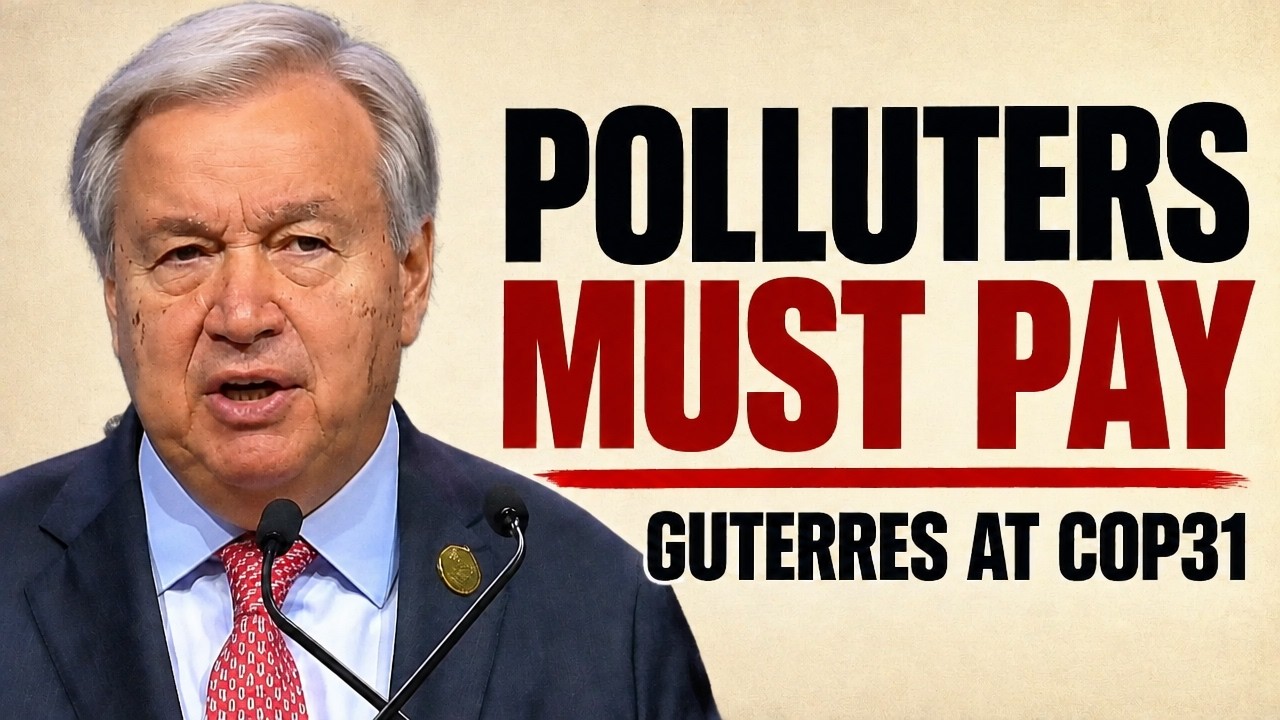
UN Secretary-General António Guterres has called for urgent action to phase out fossil fuels, proposing windfall taxes on fossil fuel profits and a new Climate Justice Compact. Speaking at the Antalya Leaders’ Summit during COP31 in Antalya, Türkiye, on 11 November 2026, Guterres warned that the climate crisis is outpacing global responses, emphasizing that clean energy, finance, and cooperation remain crucial to shaping a positive outcome.
The Inevitable Overshoot and Urgent Imperative
Guterres highlighted that global emissions reached an all-time high in 2025, with the last four years being the hottest on record. He acknowledged that an overshoot of the Paris Agreement’s 1.5°C limit is now unavoidable, but stressed that concerted action could still limit its height, duration, and overall damage, preventing a temporary breach from becoming a permanent climate sentence.
The Secretary-General linked climate policy directly to energy security, living costs, and global stability. He noted that three-quarters of humanity reside in fossil fuel-importing nations vulnerable to uncontrollable price shocks. Guterres also criticized fossil fuel lobbying for distorting science and delaying essential policy, action, and accountability, positioning renewable energy as a vital route to independence from volatile fossil fuel markets.
Progress and Persistent Gaps in Climate Action
Despite the challenges, Guterres pointed to significant progress in clean energy. Solar power, which constituted 1% of global electricity a decade ago, met nearly three-quarters of the growth in electricity demand last year, becoming the cheapest new electricity source in most parts of the world. Electric car sales have also surged, from one in 100 new sales a decade ago to an expected nearly one in three this year.
However, he cautioned that current national climate plans, even with conditional commitments, deliver only a third of the approximately 6% annual emissions cuts required. Full implementation of these plans would still lead to warming above 2.5°C by the century’s end. A significant investment disparity persists, with emerging and developing economies outside China, representing nearly two-thirds of humanity, receiving less than a fifth of clean energy investment and often paying two to three times more to borrow.
Guterres underscored the unequal burden of responsibility: developed countries should accelerate emissions cuts and deliver promised finance and technology; emerging economies should speed up their transitions; and developing countries require substantial adaptation support. He starkly contrasted the $95 billion earned by the nine largest oil companies in the last quarter with the approximately $600 million received by the Loss and Damage Fund, equating the latter to roughly 14 hours of those companies’ profits.
Four Pillars for Climate Justice and a Fairer Future
Guterres outlined four key pillars for global climate action:
- Accelerate a Just Transition: By 2035, renewable capacity should at least triple from 2025 levels, and unabated coal power should fall by at least 75%. By 2040, he called for its near phase-out, alongside a one-third cut in oil and gas use. Priorities include credible national roadmaps, worker protection, methane reductions, improved grids, storage, electrification, and protecting natural ecosystems. New fossil fuel infrastructure must not jeopardize the 1.5°C target.
- Protect People: This pillar emphasizes adaptation plans, universal early-warning systems, and protection against floods, droughts, and rising seas, all supported by swift and accessible loss-and-damage funding.
- Mobilise Finance: Developed countries are urged to lead by providing at least $300 billion annually by 2035, tripling adaptation finance by then, and transforming the $1.3 trillion goal into actual flows. Guterres called for banks to exceed the $120 billion annual Baku commitment for 2030, for donors to replenish the Green Climate Fund and Loss and Damage Fund, and for increased private investment and South-South cooperation. He reiterated his call for windfall taxes to aid vulnerable countries in recovery.
- Choose Cooperation: Guterres argued that trade barriers, technology monopolies, and geopolitical rivalries impede a faster, more affordable, and inclusive transition. Negotiations must deliver concrete action on grids, critical minerals, methane, and early warning systems.
“Fossil fuels must go the way of the dinosaurs,” Guterres declared, adding, “Polluters must pay.” He pledged, “I will not stop telling the truth.” Framing climate action as an agenda for development, peace, security, and human dignity, Guterres thanked various advocates and stated that while he would no longer be Secretary-General next year, he would remain a dedicated advocate and ally.
What did Guterres propose at COP31?
António Guterres proposed windfall taxes on fossil fuel profits and a new Climate Justice Compact. He also outlined four pillars for climate action, including accelerating a just transition, protecting people, mobilising finance, and fostering cooperation.
Why did Guterres call for windfall taxes?
Guterres called for windfall taxes to help vulnerable countries recover from climate impacts, highlighting the vast profits of oil companies compared to the limited funds available for loss and damage.
What are the four pillars of climate action Guterres outlined?
The four pillars are: accelerating a just transition away from fossil fuels, protecting people through adaptation and loss-and-damage support, mobilising substantial climate finance, and fostering global cooperation to overcome barriers.