
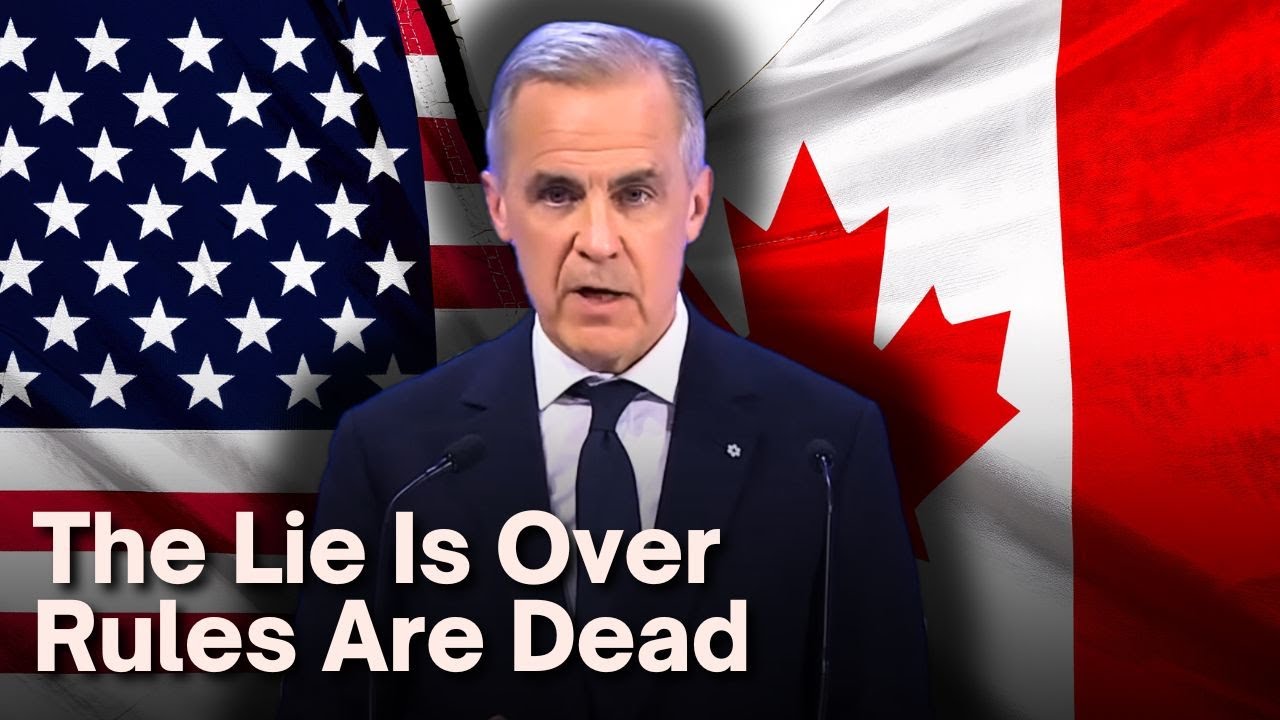
Speaking at the World Economic Forum in Davos, Canadian Prime Minister Mark Carney delivered a forceful address warning that the global rules-based order is no longer merely evolving but has suffered a decisive rupture. Carney said the world has entered a harsher geopolitical reality defined by unconstrained great-power rivalry and the weaponisation of economic interdependence.
He argued that tariffs, financial systems, and supply chains are now being used as tools of coercion rather than mutual benefit. According to Carney, this shift marks the end of what he described as a “pleasant fiction” that rules alone could guarantee fairness, security, and prosperity.
Drawing on the ideas of Czech dissident Václav Havel, Carney referenced the essay The Power of the Powerless to illustrate how systems endure not only through force, but through widespread compliance with ideas people privately know are false. He warned that countries and companies risk sustaining a failing global system by continuing to act as if its promises still hold.
“For decades, countries like Canada prospered under the rules-based international order,” Carney said, acknowledging that the system delivered stability, open trade routes, and collective security, particularly under American hegemony. However, he stressed that the selective enforcement of trade rules and international law was long understood but tolerated for the sake of predictability.
That compromise, he said, is no longer viable. Carney pointed to repeated crises in finance, health, energy, and geopolitics as evidence that extreme global integration has exposed serious vulnerabilities. He warned that institutions such as the World Trade Organization and the United Nations are increasingly under strain, leaving middle powers more exposed.
As a result, many states are pursuing strategic autonomy in food, energy, critical minerals, finance, and defence. While understandable, Carney cautioned that a world of isolated fortresses would be poorer, more fragile, and less sustainable. He argued that sovereignty can no longer rest on shared rules alone but increasingly depends on resilience and the ability to withstand pressure.
Carney urged middle powers to pursue collective solutions, warning that unilateral risk management comes at a high cost. Shared investment in resilience, common standards, and cooperation, he said, are more efficient than fragmentation.
Outlining Canada’s response, Carney said the country has abandoned the assumption that geography and alliances automatically guarantee security and prosperity. He highlighted what Finnish President Alexander Stubb calls “value-based realism” — a strategy that combines firm commitment to sovereignty, territorial integrity, human rights, and the UN Charter with pragmatic engagement in a divided world.
Carney concluded by urging countries to face reality as it is, not as they wish it to be, and to stop “living within a lie” that no longer serves their interests or values.
