
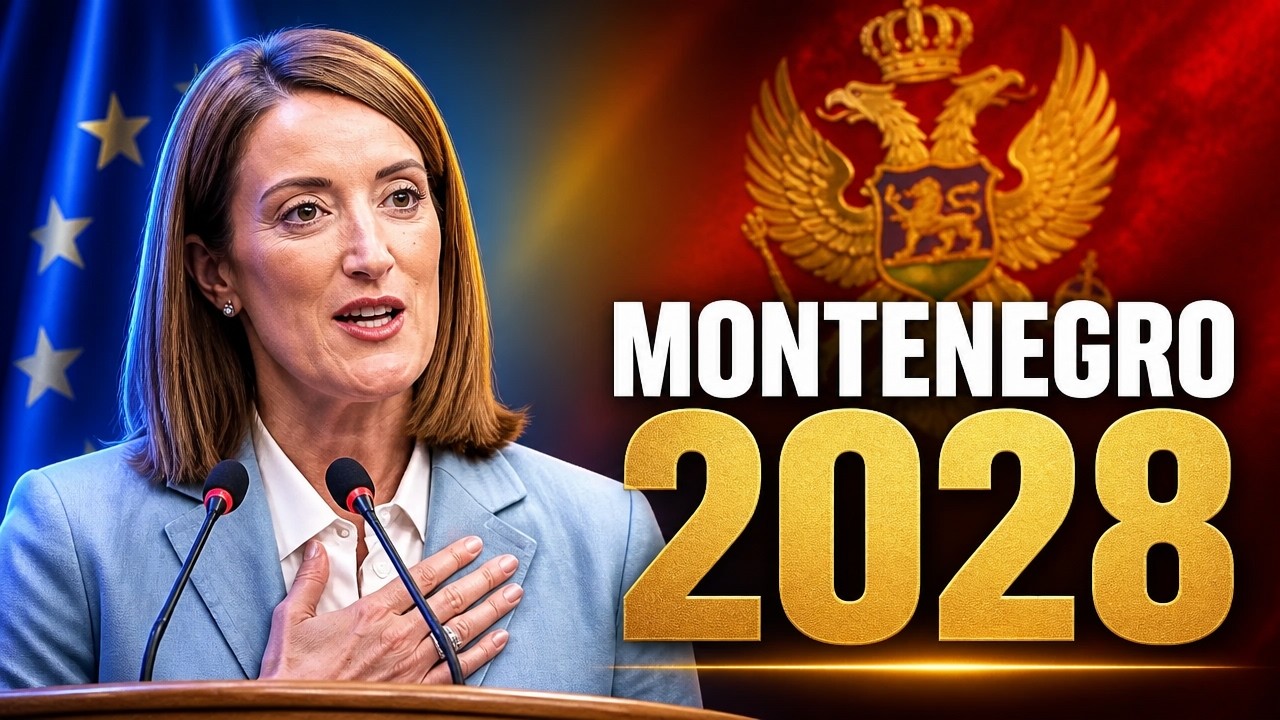
European Parliament President Roberta Metsola, during a significant address to the Parliament of Montenegro in Podgorica on June 4, 2026, affirmed Montenegro’s future within the European Union. She outlined an ambitious path for Montenegro EU accession by 2028, characterizing this period as “Europe’s enlargement moment” and a crucial strategic investment in continental stability and security.
Montenegro EU accession path set out by Metsola
President Metsola emphasized that the EU enlargement process is now a critical strategic imperative, not merely a technicality. She acknowledged Montenegro’s substantial progress, noting that nearly half of its accession chapters have already been closed, with two more expected soon. A key announcement was the commencement of work on drafting Montenegro’s accession treaty, marking a concrete step towards full membership.
Strategic Investment and Financial Support
The speech also detailed the practical and financial advantages of integration. Metsola referenced the European Parliament’s approval of the €6 billion Reform and Growth Facility for the Western Balkans, with over €383 million specifically allocated to Montenegro. These investments are designed to stimulate economic growth, enhance public services, and support youth employment, aiming to translate the accession process into visible improvements for Montenegrins, including better job prospects, improved infrastructure, and deeper market integration.
Reforms Crucial for Integration
Montenegro has set an ambitious target to become the EU’s 28th member by 2028. Achieving this goal would require continued robust reforms, particularly in combating corruption, strengthening the rule of law, and ensuring judicial independence. The European Union continues to support these efforts, recognizing their importance for successful integration.
National Identity and European Unity
Metsola directly addressed concerns about smaller nations potentially losing their identity or influence within the Union. Drawing on her experience as a leader from Malta, a small island nation, she asserted that within the EU, the “strength of your arguments” holds more weight than a country’s size. Her personal journey served as an example of how individuals from smaller states can achieve prominent European roles.
She conveyed an inspiring message to young Montenegrins: it is possible to be proudly Montenegrin and proudly European simultaneously. Metsola distinguished patriotism, which she framed as compatible with European unity, from nationalism, which she described as an inward-looking force that impedes progress and cooperation. This distinction aimed to reassure citizens that European integration does not diminish national pride but rather enhances it within a broader framework of shared values.
Montenegro’s Integration Journey
- 2006: Montenegro restored its independence and committed to a European future.
- Euro Adoption: The nation adopted the euro, aligning its economy with the European financial space.
- NATO Membership: Montenegro joined NATO, reinforcing its Euro-Atlantic security orientation.
- SEPA Membership: Integration into the Single European Payments Area streamlined cross-border financial transactions.
- EU Foreign Policy Alignment: Montenegro fully aligns with the EU’s common foreign and security policy.
- European Programmes: Active participation in initiatives like Horizon Europe and Erasmus+ fosters opportunities in research, education, and youth.
- Market and Mobility: Progress continues towards roaming-free access, visa liberalisation, and reduced barriers across the Western Balkans.
- 2026: Drafting of Montenegro’s EU accession treaty commenced.
- 2028: Montenegro’s ambitious target year for full EU membership.
FAQ
What did Roberta Metsola mean by “Europe’s enlargement moment”?
Metsola used this phrase to describe the current period where EU enlargement is viewed as a critical strategic investment in the stability, security, prosperity, and liberty of the entire European continent, especially given the geopolitical landscape.
What progress has Montenegro made towards EU membership?
Montenegro has closed nearly half of its accession chapters, with two more expected soon. Crucially, work has begun on drafting its accession treaty, and the country benefits from over €383 million from the €6 billion Reform and Growth Facility for the Western Balkans.
How did Metsola address concerns about national identity within the EU?
Drawing on her background from Malta, Metsola emphasized that within the EU, the “strength of your arguments” matters more than a country’s size. She distinguished patriotism, compatible with European unity, from nationalism, an inward-looking force, assuring Montenegrins they can be proudly Montenegrin and proudly European.
