
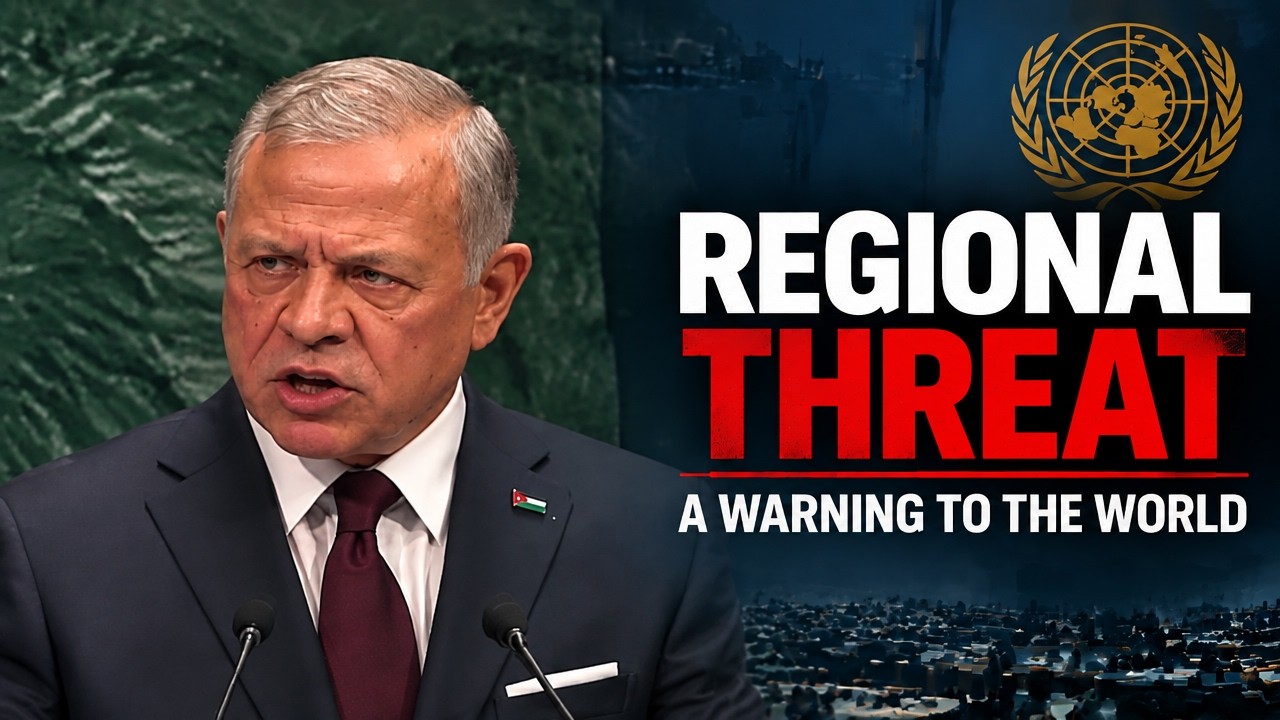
King Abdullah II of Jordan delivered a forceful and emotionally charged address to the United Nations General Assembly in New York, issuing a stark warning about the escalating conflicts in Gaza, the West Bank, Syria, and the wider consequences of prolonged war and political inaction. The Jordanian monarch questioned the credibility of international law if violations go unanswered and declared that instability in the Middle East reaches far beyond the region, impacting economies from Mumbai to Madrid to Minnesota.
Global Repercussions of Regional Instability
Abdullah began his speech by highlighting how conflicts from Lebanon to Yemen and Sudan are deepening humanitarian suffering and affecting economies globally. He pointed to higher energy and grocery costs as a direct consequence, illustrating how regional instability can have far-reaching international implications.
Gaza, West Bank, and War Crime Accusations
Turning to Gaza, King Abdullah II questioned the value of international law when it cannot be enforced. He stated that during the first 300 days of what he called the “so-called ceasefire,” at least 300 Palestinian children were killed, and Jordanian field hospitals were also targeted. His address became sharper when discussing the West Bank, where he described settlement expansion, land seizures, violence, and displacement, using terms such as “forcible transfer,” “de facto annexation,” and “a system of subjugation.” In one of the most direct moments, he asserted that these developments amount to: “Forced displacement. And that is a war crime.”
Jordan’s National Security and Regional Threats
Abdullah’s message extended beyond the Israeli-Palestinian conflict to broader regional security. He warned that, in his assessment, Israel’s actions are no longer confined to Palestine, describing the Israeli government’s “expansionist appetite” as a regional threat. He specifically cited developments in Syria, including incursions, territorial expansion, and issues surrounding water resources. For Jordan, Abdullah drew a clear security line, stating: “Any threat to our northern border or our water security is a threat to our national security.” He followed this with an equally direct declaration: “Jordan will not look away.”
A Call for International Accountability
The King also challenged the wider international community over its response to these issues. He explicitly listed sanctions, asset freezes, embargoes, and diplomatic isolation among the tools available to governments, arguing that resolutions concerning Israel have remained “on paper.”
Towards Lasting Solutions and Global Trust
King Abdullah II closed his speech with a broader international message, connecting the suffering of people in Gaza, Sudan, and Ukraine. He argued that “Military force cannot deliver meaningful solutions” and emphasized that international cooperation ultimately depends on trust between nations, trust in agreements, and confidence that rules will actually be enforced.
What did King Abdullah II say about the West Bank?
King Abdullah II described developments in the West Bank, including settlement expansion, land seizures, violence, and displacement, using terms like “forcible transfer,” “de facto annexation,” and “a system of subjugation.” He explicitly stated that “Forced displacement. And that is a war crime.”
What were King Abdullah II’s warnings about regional stability?
King Abdullah II warned that conflicts across the Middle East, from Lebanon to Yemen and Sudan, are deepening humanitarian suffering and affecting economies far beyond the region, citing examples of higher energy and grocery costs in cities like Madrid, Mumbai, and Minnesota.
What did King Abdullah II say about international law?
King Abdullah II questioned whether international law can retain credibility if violations go unanswered, particularly in the context of Gaza and the West Bank. He also argued that resolutions concerning Israel have remained “on paper” and that international cooperation relies on confidence that rules will be enforced.
