
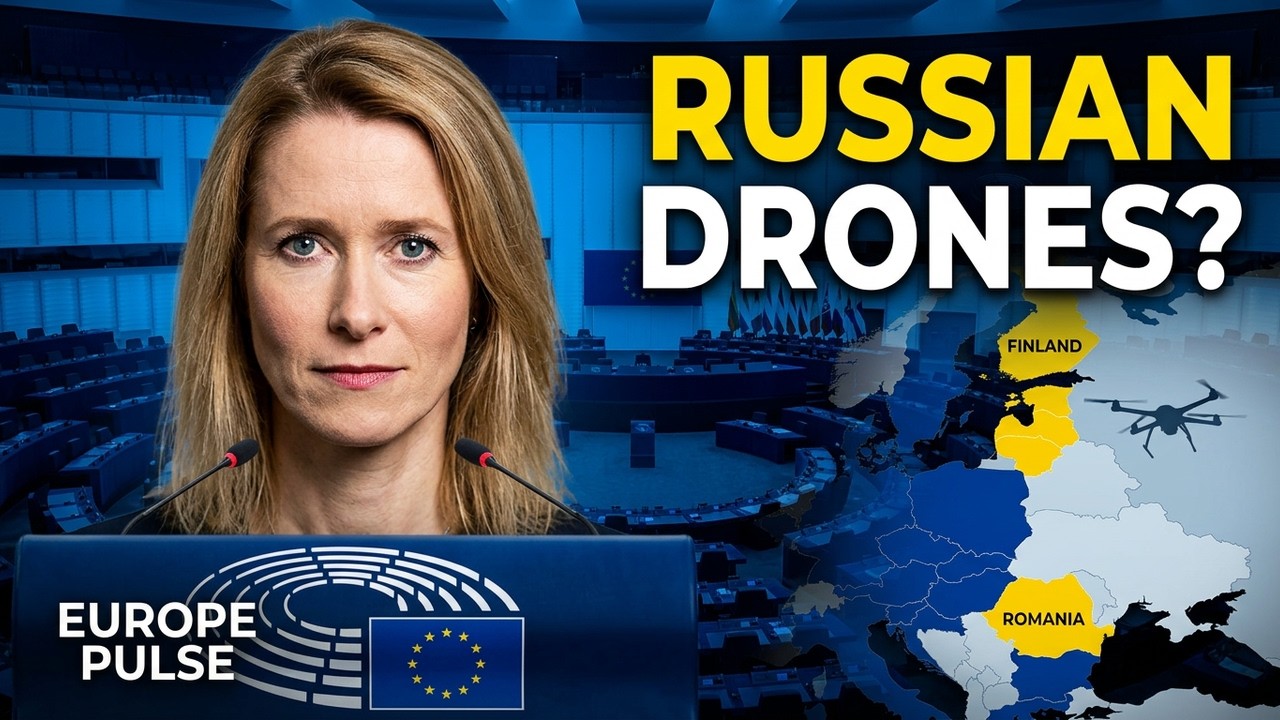
The European Parliament recently convened in Strasbourg to address Russia’s reported drone incursions and provocative actions near the EU’s eastern border, highlighting a growing security challenge for the continent. During the debate, MEPs and EU High Representative Kaja Kallas focused on strengthening European air defence capabilities, asserting sovereignty, and ensuring the protection of citizens.
Europe’s Evolving Security Landscape
The discussion in Parliament was prompted by a series of security incidents affecting Romania, the Baltic states, and Finland. Notably, a Russian drone reportedly carrying explosives crashed into a residential building in Romania, underscoring the tangible threat posed by such incursions. Kaja Kallas emphasized that Europe is confronting an unprecedented frequency and severity of cyber attacks, disinformation campaigns, sabotage, disruption, and repeated drone incursions into EU airspace.
Kallas stated that Russia represents “the most direct and immediate threat to the security of the European Union,” pointing not only to the ongoing war against Ukraine but also to hybrid tactics targeting European societies and institutions. She stressed the importance of a calm, united, and firm response, noting that all 27 EU member states demonstrated unity in their May 29 statement regarding violations of EU airspace by Russia.
Calls for Enhanced European Drone Defence and Monitoring
MEPs from various political groups responded to these concerns with urgent calls for action. Key proposals included stronger monitoring mechanisms, the development of advanced early warning systems, and the deployment of robust anti-drone capabilities. There was a significant emphasis on bolstering air defence on the eastern flank of the EU and improving overall border protection. Several speakers also advocated for stronger European funding to support these defensive mechanisms.
Reinis Pozņaks warned that “cheap destructive technologies are already a present threat, not a future risk,” highlighting the immediate need for effective countermeasures. Petras Auštrevičius called for a stronger asymmetric EU response, suggesting more severe financial and economic sanctions against Russia as part of a broader strategy.
The Challenge of Cost-Effective Defence
A central theme of the debate was the practical challenge facing Europe’s defence planners: how to effectively counter cheap drones without relying solely on costly missile interceptors. This dilemma underscores the need for innovative and budget-conscious solutions. MEPs argued that air defence, anti-drone systems, and civil protection initiatives, particularly on the eastern flank, must become urgent budget and security priorities for the Union.
The debate also highlighted the critical need for precision in describing incidents. Pierre-Romain Thionnet cautioned, “We must make sure to remain precise in the description of all incidents,” warning that inaccurate claims could be exploited by propaganda to discredit Europe’s position and undermine its credibility.
Ensuring Citizen Safety and European Unity
The overarching sentiment was a commitment to ensuring the safety of European citizens. Victor Negrescu articulated this by stating, “Each European citizen has the right feel safe in your own home.” The discussions underscored growing concern within the European Parliament that Russia’s pressure on EU borders extends beyond conventional military threats, encompassing a range of hybrid tactics designed to destabilize and provoke.
As Europe navigates this complex security environment, the calls for enhanced collective defence, strategic investment in anti-drone technologies, and unwavering unity remain paramount. The Strasbourg debate served as a clear signal that the EU is taking these evolving threats seriously and is committed to developing a robust and coordinated response.
Frequently Asked Questions
What was the main topic of the European Parliament debate?
The debate in the European Parliament focused on Russia’s provocative actions and drone incursions near the EU’s eastern border, specifically affecting Romania, the Baltic states, and Finland, and the need for stronger European air defence.
Who is Kaja Kallas and what was her role in the debate?
Kaja Kallas is the EU High Representative. During the debate, she warned that Europe faces unprecedented cyber attacks, disinformation, sabotage, and drone incursions, describing Russia as “the most direct and immediate threat” to EU security.
Why are cheap drones a security challenge for Europe?
Cheap drones pose a security challenge because they can be used for provocative actions and incursions, yet effectively defending against them often requires costly missile interceptors. This creates a practical dilemma for Europe’s defence planning and budget priorities.
