
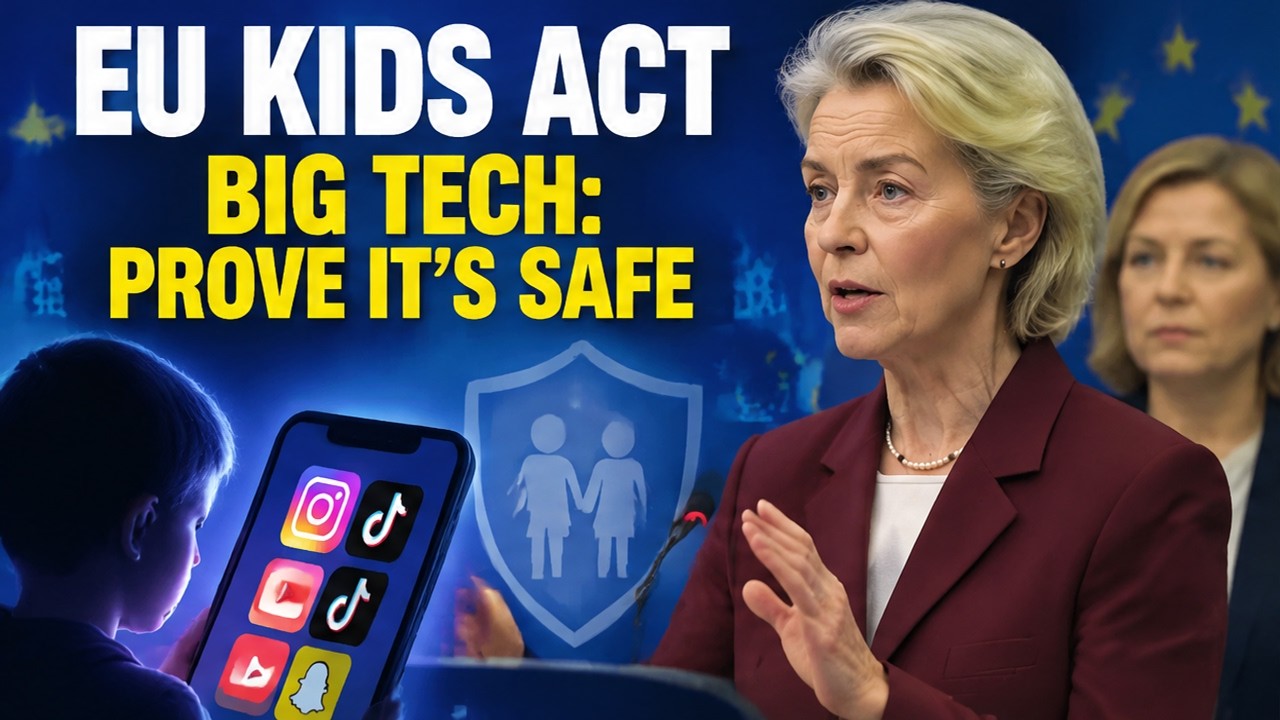
The European Commission has unveiled its proposal for an EU Kids Act, a legislative initiative designed to introduce new age-based rules for children using social media and to impose stronger safety obligations on online platforms. Commission President Ursula von der Leyen and Executive Vice-President Henna Virkkunen presented the framework, emphasizing a shift in responsibility towards technology companies and greater parental control over children’s online engagement.
Age-Based Protections and Restrictions
The proposed EU Kids Act outlines a tiered system of protection based on age. Under the Commission’s plan, children below the age of 13 would not be permitted to have social media accounts. For those between 13 and 15, access would be possible through supervised “mini accounts” established by parents or guardians. These accounts would feature restricted functionalities and a proposed maximum usage time of one hour per day.
From the ages of 15 to 18, young people could have personal accounts, but platforms would still be required to comply with mandatory safety-by-design protections. These rules are envisioned to cover a broad range of services, including social media platforms, video-sharing platforms, AI companions, AI chatbots, and online video games where harmful features are present.
Shifting Responsibility to Platforms
A central element of the proposal is a fundamental change in how platform safety would be enforced. Ursula von der Leyen stated, “Parents cannot compete or keep up against algorithms and they should not have to.” She added that the Commission aims to reverse the burden of proof, requiring major platforms to provide detailed child-safety plans and demonstrate their services are safe before minors can access them. “Now they have to prove to US that they are safe,” von der Leyen affirmed.
Executive Vice-President Henna Virkkunen explained that the proposal builds upon the existing Digital Services Act, making its safety-by-design guidelines binding. The Commission also proposes a streamlined 90-day procedure for investigations concerning the protection of minors.
Enhanced Safeguards and Age Verification
Among the specific safeguards outlined, the proposal would prevent strangers from messaging children, restrict personalized advertising and algorithms based on past activity for minors, and prohibit addictive features. For AI services, chatbots and companions aimed at minors would not be allowed to mimic human friends to create emotional dependency. They would also be prevented by default from carrying a child’s earlier conversations into later interactions, with risks requiring testing before launch and ongoing monitoring.
The Commission also proposes privacy-preserving age verification, with von der Leyen noting that an EU-certified application would use zero-knowledge proof. This technology would allow platforms to verify a user meets the relevant age requirement without receiving additional personal information.
Public Support and Concerns
The Commission’s case for tighter online protection for children is supported by Eurobarometer figures cited by Ursula von der Leyen. These figures indicate that 92% of Europeans support stronger protection for children and young people online, while around 70% are concerned about issues such as cyberbullying, harassment, and grooming. Von der Leyen highlighted the significant screen time young Europeans accumulate, averaging four to six hours per day, which rises to seven to eight hours for those who started using social media before age 10.
“Because we trust parents. They are the most important in bringing up their children,” von der Leyen concluded, underscoring the proposal’s aim to empower parents in the digital age.
What is the EU Kids Act?
The EU Kids Act is a proposal from the European Commission to introduce new age-based rules for children’s social media use and stronger safety obligations for online platforms across the European Union.
What are the proposed age restrictions for social media?
Under the proposal, children under 13 would not have social media accounts. Those aged 13 to 15 could use supervised “mini accounts” with restricted features and a one-hour daily limit. Young people aged 15 to 18 would have personal accounts, but platforms would still need to comply with safety-by-design rules.
How would the EU Kids Act change platform responsibility?
The proposal aims to shift the burden of proof, requiring major platforms to demonstrate their services are safe for minors before access, rather than authorities proving harm after it occurs. It would also make safety-by-design guidelines binding and introduce a 90-day investigation procedure for minor protection cases.
