
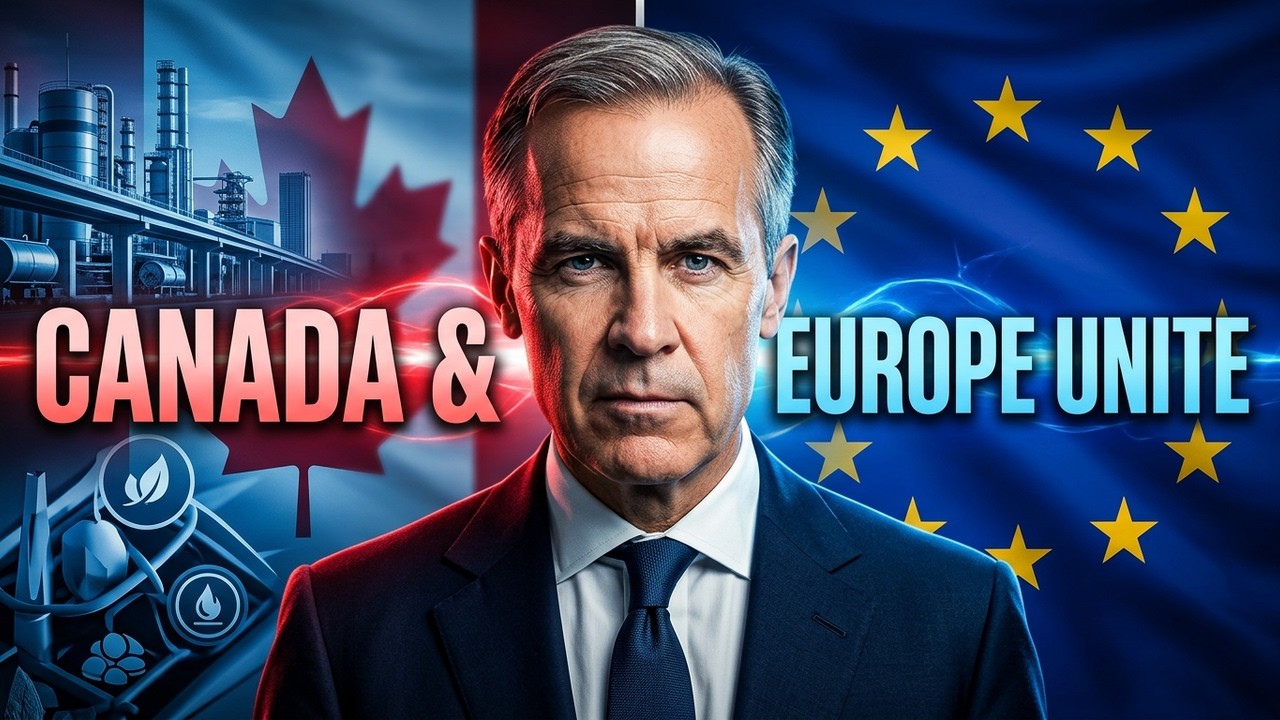
Canadian Prime Minister Mark Carney has outlined a strategic vision for Canada, presenting it as a more sovereign, investment-driven, and globally connected economy, with Europe emerging as a pivotal strategic partner. Speaking at the Canada Investment Summit, Carney described Canada as both a “safe harbor” and a “base to build” within a new global economic order characterized by deeper divisions and strategic competition.
A Strategy for Strategic Autonomy
Carney’s response to the evolving global landscape is built on two core ideas: strengthening Canada domestically and diversifying its international partnerships. Cooperation with the European Union is central to this strategy, encompassing defence, trade, critical minerals, clean energy, technology, and the pursuit of strategic autonomy.
He argued that economic integration can no longer be viewed solely as a source of efficiency, noting that tariffs, financial systems, and supply chains can be leveraged as instruments of coercion and vulnerability. Consequently, Canada aims for greater domestic capacity in key sectors such as defence, energy, artificial intelligence, payments, space, and critical minerals, while combining these capabilities with trusted international partners.
Deepening Europe Ties
The Canadian Prime Minister highlighted Canada’s existing role as the only non-European member of SAFE, which he described as the EU’s defence procurement initiative. Furthermore, Carney announced that Canada intends to begin discussions with the EU “next month” on what he termed a “unique security and economic alliance.”
This European connection extends to infrastructure plans, with Canada seeking new infrastructure, including a sovereign broadband backbone, featuring more direct and secure links to Europe and Asia. New Atlantic ports and trade gateways are also part of Canada’s effort to connect more closely with both regions. Carney framed this closer cooperation with Europe as an integral part of Canada’s broader strategy for strategic autonomy, moving beyond conventional trade diplomacy to a wider security and economic architecture.
Domestic Investment and Defence Commitments
Carney’s speech also detailed significant domestic investment measures, aiming to catalyze $1 trillion of investment over five years in sectors including energy, transportation, technology, data, and defence. He highlighted 27 nation-building initiatives, representing around $500 billion in private investment opportunities, which have been referred to the new Major Projects Office.
A new investment regime was announced, including immediate expensing for most new capital investment and a faster approval framework based on “one project, one review, one year.” Canada also plans to seek private investment through long-term concessions to operate its four largest airports while retaining public ownership.
Economically, Canada has signed more than 50 critical-minerals agreements with over 15 countries, unlocking $20 billion in investment, and more than 20 trade and security deals across five continents. On defence, Canada is undertaking its biggest spending increase since the Second World War, has met its NATO obligations, and has budgeted a path toward 4% of GDP in total defence spending by 2030.
Maintaining the US Relationship
While emphasizing diversification, Carney made clear that Canada is not abandoning its relationship with the United States. He affirmed that the two countries will always be neighbours and that Canada will remain an important US partner. The broader message is one of diversification, aiming for a stronger, more resilient, and more independent Canada that engages in international relationships from a position of greater domestic capacity.
What is Canada’s new economic strategy?
Canada’s new economic strategy, as outlined by Prime Minister Mark Carney, aims to strengthen the country domestically and diversify its international partnerships. It seeks to catalyze $1 trillion in investment over five years, focusing on strategic sectors like energy, technology, and defence, and includes regulatory reforms to attract private investment.
How does Canada plan to strengthen ties with Europe?
Canada plans to strengthen ties with Europe through discussions on a “unique security and economic alliance,” increased cooperation in defence procurement (as the only non-European member of SAFE), trade, critical minerals, clean energy, and technology. It also seeks new infrastructure with direct and secure links to Europe.
What are Canada’s defence spending plans?
Canada is undertaking its biggest defence spending increase since the Second World War, has met its NATO obligations, and has budgeted a path toward 4% of GDP in total defence spending by 2030.