
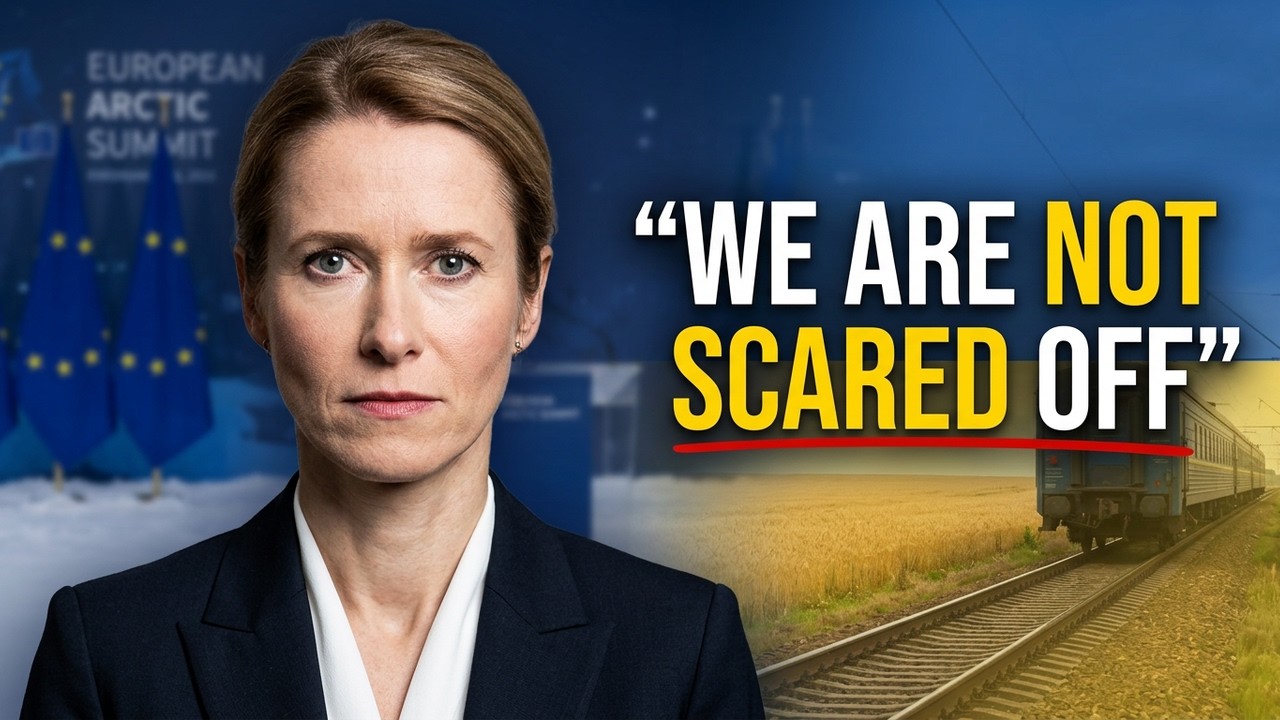
European leaders gathered at the European Arctic Summit in Rovaniemi, Finland, where Estonian Prime Minister Kaja Kallas asserted that Europe is “not scared off” by reported Russian aggression. Kallas’s remarks followed a reported Russian strike on a train station in western Ukraine, which she described as an attempt to intimidate Western countries and deter political figures from visiting Ukraine.
Europe Stands Firm on Arctic Security and Ukraine
Speaking at the summit, Kallas emphasized that the strike was “clearly a message to the western world,” and Europe should respond by demonstrating unwavering support for Ukraine. “We should show that we are there for Ukraine and we are not scared off,” she stated.
The summit provided a platform for a broader debate on Arctic security, Russia’s actions, hybrid threats, and continued European support for Ukraine. Finnish Prime Minister Petteri Orpo highlighted that Europe’s security environment has “changed fundamentally” and described the Arctic as a central arena of great-power competition. He called Russia the most significant long-term threat to Arctic security and stability and noted that Finland’s border with Russia is more than 1,300 kilometres long. Orpo affirmed, “The Arctic is a core European security interest and an integral part of European security.” He argued that Russia’s growing aggression, intended to divide Europe, should instead lead to increased support for Ukraine, further sanctions, and stronger measures against Russia’s shadow fleet.
Adapting Arctic Policy to New Realities
European Council President António Costa underscored the interconnectedness of developments in the High North with the entire European Union. With Denmark, Finland, and Sweden being Arctic EU member states, Costa stressed the need for Europe to adapt its Arctic policy to a new geopolitical reality, stating, “What happens here is not a regional story. It is a European one.” The European Commission and European External Action Service are preparing an updated EU Arctic strategy, with Kallas confirming security will be at its core. Discussions included possible investment in icebreaking capacity, military mobility, dual-use transport networks, critical raw materials, and space capabilities.
German Chancellor Friedrich Merz declared that the period of limited European attention to the region is over, asserting, “High north and low attention is over.” Merz characterized the Arctic as a geopolitical hotspot, accusing Russia of military buildup and hybrid activities, and called for stronger EU engagement alongside NATO. He also suggested including Iceland, Norway, Canada, and the United Kingdom in future Arctic security discussions.
Greenland and Broader Threats to European Resilience
Greenland emerged as another significant topic. Danish Prime Minister Mette Frederiksen mentioned an ongoing high-level working group between the Kingdom of Denmark and the United States, with 10 allies exercising together in Greenland. Costa reaffirmed EU solidarity with the Kingdom of Denmark, emphasizing territorial integrity as a key issue for the Union, and referred to proposals to double EU investment in Greenland in the next long-term budget.
Estonian Prime Minister Kristen Michal directly linked Arctic security with the Baltic Sea region, warning about Russia’s military buildup and shadow fleet, and highlighted Estonia’s role in rare earth mineral processing. Romanian President Nicușor Dan called for greater European cooperation, information-sharing, and stronger capabilities to protect citizens against sabotage, cyberattacks, disinformation, drone incidents, and attacks on critical infrastructure.
Unwavering Support for Ukraine
Ukraine remained central to the summit’s closing discussions. Chancellor Merz warned that Europe might be approaching some of the most decisive weeks or months for the continent’s freedom and peace, insisting that support for Ukraine must continue. This collective resolve echoed Kallas’s initial message: attempts to intimidate Europe should not result in retreat, but rather in reinforced commitment.
What was the main message from Kaja Kallas at the Arctic Summit?
Estonian Prime Minister Kaja Kallas stated that Europe is “not scared off” by reported Russian aggression, including a strike near the Polish border, and urged Western countries to show continued support for Ukraine.
Why is the Arctic region a key focus for European security?
Leaders at the summit, including Finnish Prime Minister Petteri Orpo and European Council President António Costa, emphasized that the Arctic’s security environment has “changed fundamentally,” with Russia posing a significant threat, making it a core European security interest.
What other threats did European leaders discuss at the summit?
Beyond direct military threats, leaders addressed hybrid threats such as sabotage, cyberattacks, disinformation, drone incidents, and attacks on critical infrastructure, calling for increased European cooperation and capabilities.
