
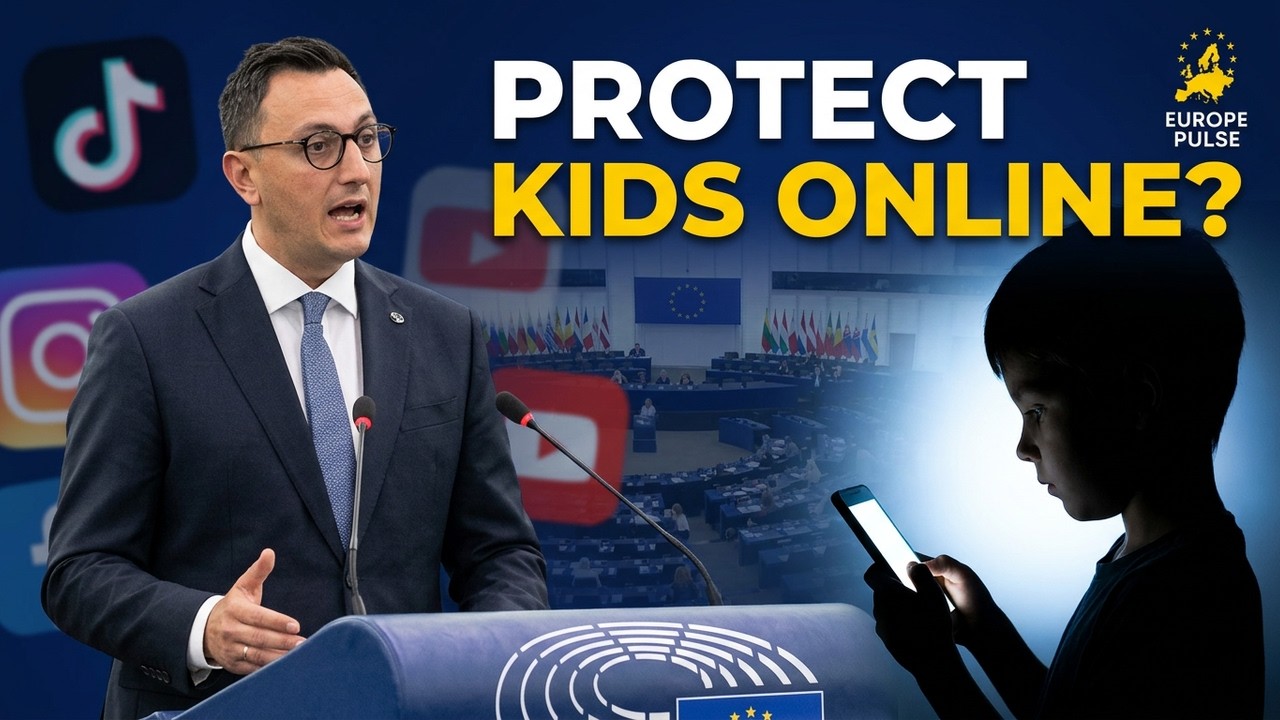
The European Parliament recently debated how the EU should protect children’s safety and mental health from risks linked to social media, with MEPs demanding stronger platform responsibility and a potential ban on addictive design. Commissioner Glenn Micallef highlighted excessive screen time as a key factor in Europe’s youth mental health crisis, while emphasizing the Digital Services Act (DSA) as the backbone of current EU enforcement.
What happened in Strasbourg
During the plenary debate in Strasbourg, Glenn Micallef, European Commissioner for Intergenerational Fairness, Youth, Culture and Sport, stated that the EU already possesses “one of the world’s most ambitious frameworks” for protecting children online. He noted that “For many young people, life is now increasingly lived online,” and affirmed, “We are enforcing the rules with rigour and with speed.”
MEPs from various groups voiced their concerns and proposals. Ewa Kopacz stressed the influence of algorithms, saying, “If we do not teach our children what respect and closeness are, an algorithm will tell them.” Alex Agius Saliba described social media addiction as “a pandemic and it requires immediate action.” Kim van Sparrentak specifically called for legislative action, stating, “It is high time to ban addictive design in Europe.” Other MEPs, including Annamária Vicsek, Antonella Sberna, Valérie Hayer, Carolina Morace, and Sarah Knafo, focused on issues such as age verification, cyberbullying, parental controls, digital literacy, and the principle that what is valid offline must be valid online.
Why it matters for Europe
This debate comes as the Parliament has called for a minimum age of 16 for social media access and stronger protection for victims of online harassment. The Commission plans to issue guidelines under the DSA by July 2025, setting benchmarks for platforms to protect minors. Commissioner Micallef also pointed to several existing and upcoming EU tools, including the Better Internet for Kids strategy, the EU action plan against cyberbullying, the Audiovisual Media Services Directive (AVMSD), the AI Act, and the GDPR. A review of the AVMSD is planned for later this year, alongside the upcoming Digital Fairness Act. The Commission is assessing whether additional legislative measures are needed.
Key points on EU addictive design and child safety
- The debate focused on children’s safety and mental health risks linked to social media.
- Parliament has called for a minimum age limit of 16 for social media access.
- The Digital Services Act (DSA) is highlighted as the core of EU efforts to protect minors online.
- Commissioner Micallef referred to preliminary findings involving TikTok, Meta, and four large pornographic platforms.
- The Commission’s age verification blueprint is complete, with EU-wide access targeted by the end of 2026.
- More than 46 million people across Europe have received support through Safer Internet Centres and the Better Internet for Kids portal.
FAQ
What is the EU doing to protect children online?
The EU is utilizing the Digital Services Act (DSA) as its primary tool for enforcement, with guidelines expected by July 2025. It also employs the Better Internet for Kids strategy, an action plan against cyberbullying, the Audiovisual Media Services Directive, the AI Act, and the GDPR. The Commission is also assessing the need for additional legislative measures, including a planned Digital Fairness Act.
What are MEPs demanding regarding social media?
MEPs are pushing for stronger platform responsibility, effective age verification, and possible age limits for social media access. There is also a strong demand to ban addictive design features in Europe to protect children’s mental health and well-being.
What is the proposed minimum age for social media access in the EU?
The European Parliament has called for a minimum age of 16 for access to social media platforms.
