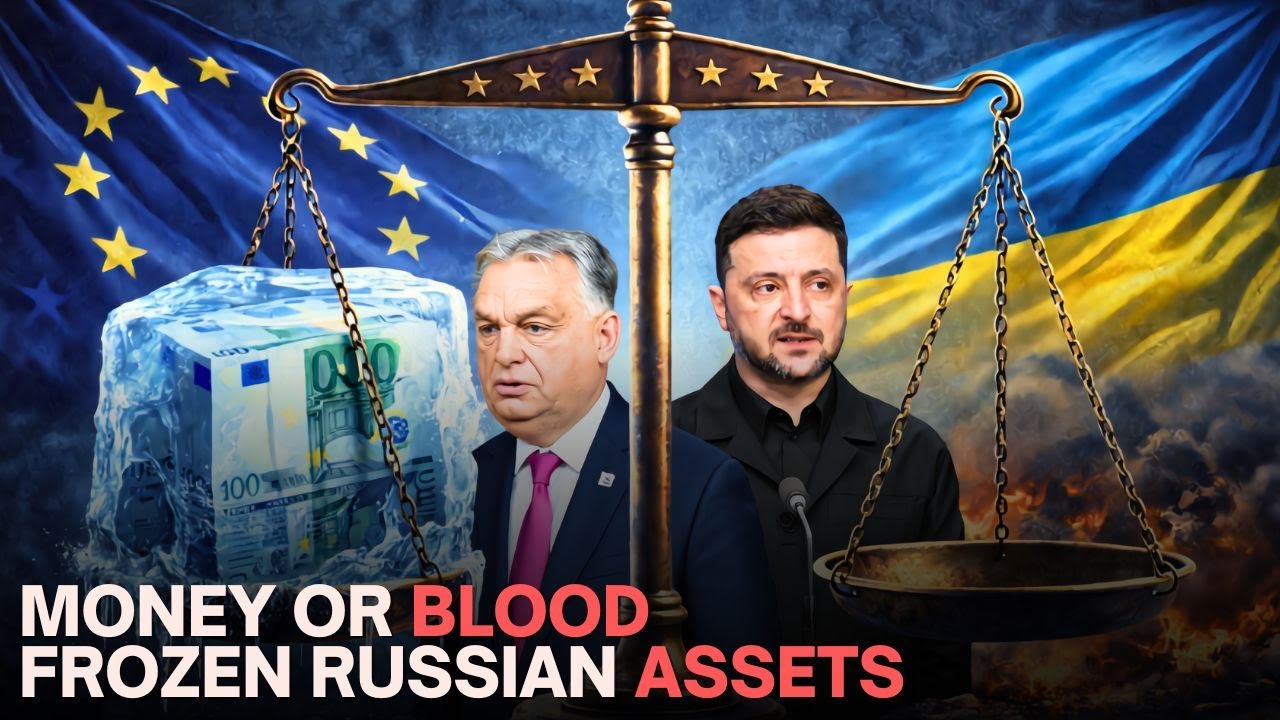
The European Union is facing one of its most consequential financial and political decisions since the start of Russia’s full-scale invasion of Ukraine: should frozen Russian assets be used to fund Ukraine’s survival in 2026 and 2027?
At a recent European Council summit in Brussels, EU leaders debated how to close Ukraine’s looming funding gap — and whether Europe is willing to take the legal and political risks that come with it.
At stake is not only Ukraine’s ability to continue defending itself, but also Europe’s credibility as a geopolitical actor.
What Are Frozen Russian Assets — and Why Belgium Matters
Since 2022, the EU and its allies have frozen roughly €210 billion in Russian state assets.
About €185 billion of that total is held in Belgium, inside the Brussels-based financial infrastructure company Euroclear, which clears and settles securities for governments and banks worldwide.
This concentration makes Belgium central — and vulnerable.
While the assets are already immobilized, turning them into usable funding raises fears of:
-
legal challenges from Russia,
-
financial retaliation,
-
and long-term damage to Europe’s reputation as a safe place to hold sovereign assets.
Belgium’s position is simple:
👉 If most of the money is in Belgium, Belgium cannot be the only one carrying the risk.
Europe’s Dilemma: Debt or Russian Money
EU leaders are weighing two main options to finance Ukraine for 2026–2027:
Option 1: Borrowing Against the EU Budget
This would involve raising money on financial markets, backed by the EU budget.
While legally safer, it is politically difficult, as it resembles joint EU debt and could trigger vetoes from skeptical member states.
Option 2: The “Reparations Loan”
The second option — and the most discussed — is a reparations loan.
Under this model:
-
frozen Russian assets would serve as the financial backbone of a loan,
-
Ukraine would receive funding immediately,
-
and the EU would avoid formally confiscating the assets.
That is why EU leaders carefully use terms like loan, collateral, and immobilized assets — not seizure.
Belgium’s Red Line: Risk Must Be Shared
Belgium insists that any reparations loan must include binding EU-wide guarantees.
If Russia sues, if compensation claims emerge, or if markets react negatively, all 27 EU states must share the burden, not just the country where the assets are physically held.
European Commission President Ursula von der Leyen and EU foreign policy chief Kaja Kallas have both argued that:
if the decision is made through EU legislation, the risk becomes European, not Belgian.
This principle of risk-sharing has become the key obstacle — and the key potential breakthrough — of the summit.
A Deep Political Split Inside the EU
Not all leaders agree.
Hungarian Prime Minister Viktor Orbán has called the idea of using frozen Russian assets “dead,” arguing that:
-
the EU is not a party to the war,
-
taking money from one warring side and giving it to the other amounts to direct involvement.
Slovak Prime Minister Robert Fico has voiced similar criticism, while the Czech government under Andrej Babiš has expressed skepticism about the financing model — even while supporting Ukraine in principle.
This has created a clear fault line inside the EU:
-
one camp sees the reparations loan as the only realistic option,
-
the other fears escalation, legal precedent, and domestic backlash.
What Happens If Europe Fails to Decide
Ukraine’s warning is blunt.
President Volodymyr Zelensky has said that without predictable funding:
-
Ukraine faces a massive budget shortfall,
-
drone production and long-range strike capacity could be sharply reduced,
-
and the country’s ability to sustain the war effort would weaken.
Politically, failure would send an even stronger signal:
Europe can freeze assets — but cannot turn economic power into action.
That is exactly the kind of hesitation Moscow hopes for.
More Than Money: A Test of Europe’s Power
This European Council summit is not just about accounting or legal engineering.
It is about whether the EU can:
-
act collectively under pressure,
-
share risks internally,
-
and remain a credible supporter of Ukraine beyond short-term emergency aid.
If leaders agree on risk-sharing, Belgium can move — and Ukraine gains financial visibility through 2027.
If they don’t, the money stays frozen, and Europe’s promise to Ukraine becomes uncertain.
The assets are frozen. The question is whether Europe itself is.