
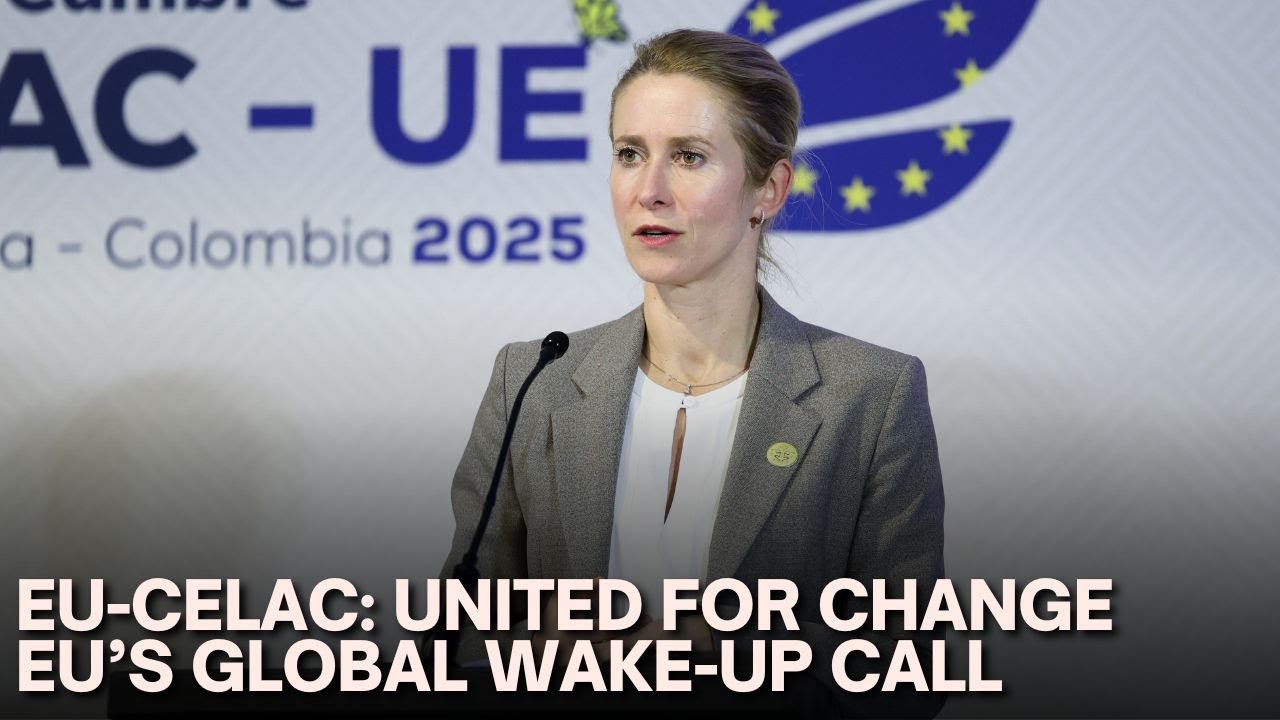
Kaja Kallas Urges CELAC Unity on Global Challenges and Launches Supercomputing, Trade, and Climate Initiatives at EU-CELAC Press Conference
#geopolitics #brussels #celac
At the EU-CELAC Summit press conference in Santa Marta, Colombia, on 9 November 2025, EU High Representative for Foreign Affairs and Security Policy Kaja Kallas delivered firm remarks underscoring Europe’s deepening partnership with Latin America and the Caribbean. Thanking President Gustavo Petro for hosting, Kallas described the summit as a moment to “renew friendship” and strengthen cooperation between two regions that “share common values and a belief in the rules-based international system.”
Kallas stressed that the EU and CELAC together represent over one-fifth of the global economy, with an expanding network of trade agreements already linking both sides. She hailed the modernization of deals with Chile and Mexico, and reiterated that the long-negotiated EU-MERCOSUR agreement would soon create the largest free trade zone in the world, enabling nearly all Latin American and Caribbean states to trade freely with the EU.
Rejecting protectionism, Kallas emphasized Europe’s commitment to “staying open” at a time when “others look inwards,” highlighting that openness drives growth, investment, and innovation.
Turning to cooperation, Kallas celebrated the BELAC fiber optic cable, which already connects 65 million people across the Atlantic. She announced plans to extend the network to Central America, Peru, and the Caribbean, alongside new initiatives including the EU-CELAC Supercomputing Network, a regional electricity integration initiative, and expanded satellite connectivity—even to “the most remote corners of the Amazon.”
Kallas linked these efforts to the EU’s Global Gateway strategy, designed to support local job creation and sustainable value chains rather than perpetuate dependency.
Addressing the escalating climate crisis, Kallas recalled the devastation caused by Hurricane Melissa, which struck the Caribbean just days earlier. The EU, she said, had responded swiftly with €21 million in emergency aid for food, health care, and relief efforts. She warned that climate change is making disasters “more frequent and more destructive” and announced that Caribbean partners will gain full access to Europe’s Copernicus satellite system for real-time storm monitoring and disaster prevention.
Kallas then pivoted to global security, underscoring that Russia’s war against Ukraine remains “an existential threat to the European Union” and a test of the international order. “If Putin is not stopped, he will not stop,” she said, stressing that “unchecked aggression only breeds more.” She called on CELAC countries to use their influence—together representing one-third of UN membership—to defend international law and sovereignty worldwide.
Kallas concluded with a message of shared purpose: Europe and CELAC, she said, are bound not only by history but by a shared conviction “that we can do better by working together.”
——————————————————
*Subscribe to Europe Pulse*
Stay updated with the latest news from Europe.
#EuropePulse #BreakingNews #EU #WorldNews #Politics #TrendingNow #NewsUpdate #Analysis #Ukraine #Russia #USA #UK #EuropeanUnion #NATO #WorldEvents #CurrentAffairs #EUnews #TopStories #InternationalNews #Brussels #Leaders #ViralNews #Headlines
